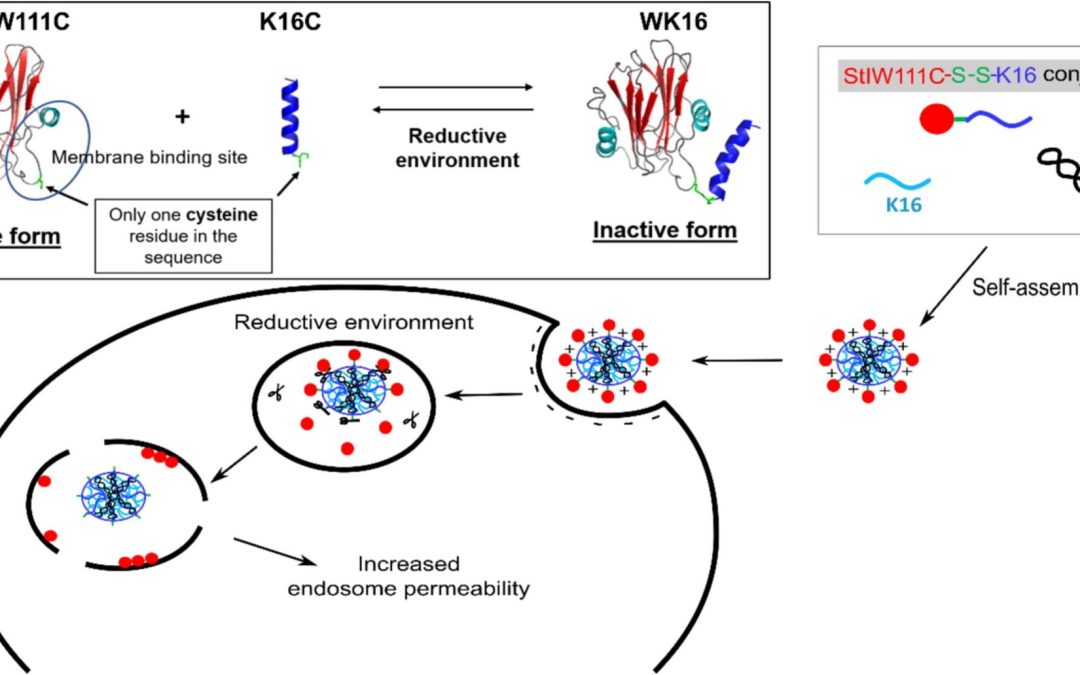
Development of a StIW111C-based bioresponsive pore-forming conjugate for permeabilizing the endosomal membrane

Development of a StIW111C-based bioresponsive pore-forming conjugate for permeabilizing the endosomal membrane

In this research, Escalona-Rodríguez and collaborators explore a non-viral strategy to deliver therapeutic genes into human cells. They develop a new molecule that combines a pore-forming protein with a DNA-binding peptide. This system helps release genetic material trapped inside cells, a key challenge in gene therapy. While the molecule succeeds in opening cellular compartments, issues like the formation of large aggregates still need to be addressed to improve gene expression.

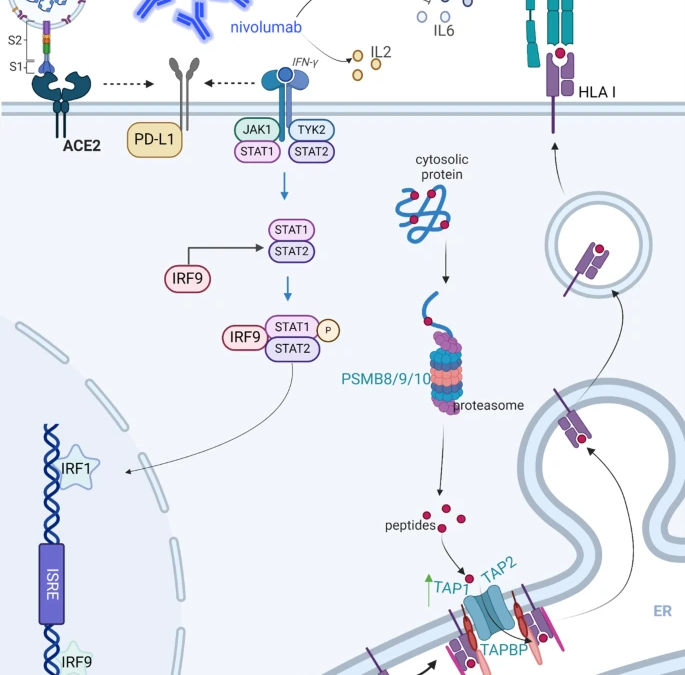
Altered ACE2 and interferon landscape in the COVID-19 microenvironment correlate with the anti-PD-1 response in solid tumors

Altered ACE2 and interferon landscape in the COVID-19 microenvironment correlate with the anti-PD-1 response in solid tumors

In this article, Subbarayan et al. evaluate how the ACE2 receptor, used by SARS-CoV-2 to enter cells, affects immune responses in cancer. The authors find that tumor cells with high levels of ACE2 show increased activation of immune-related genes and molecules. These changes may influence how well cancer patients respond to immunotherapy, especially when infected with COVID-19. The study suggests that targeting the ACE2-related immune pathway could help reduce COVID-19 severity in patients with cancer.

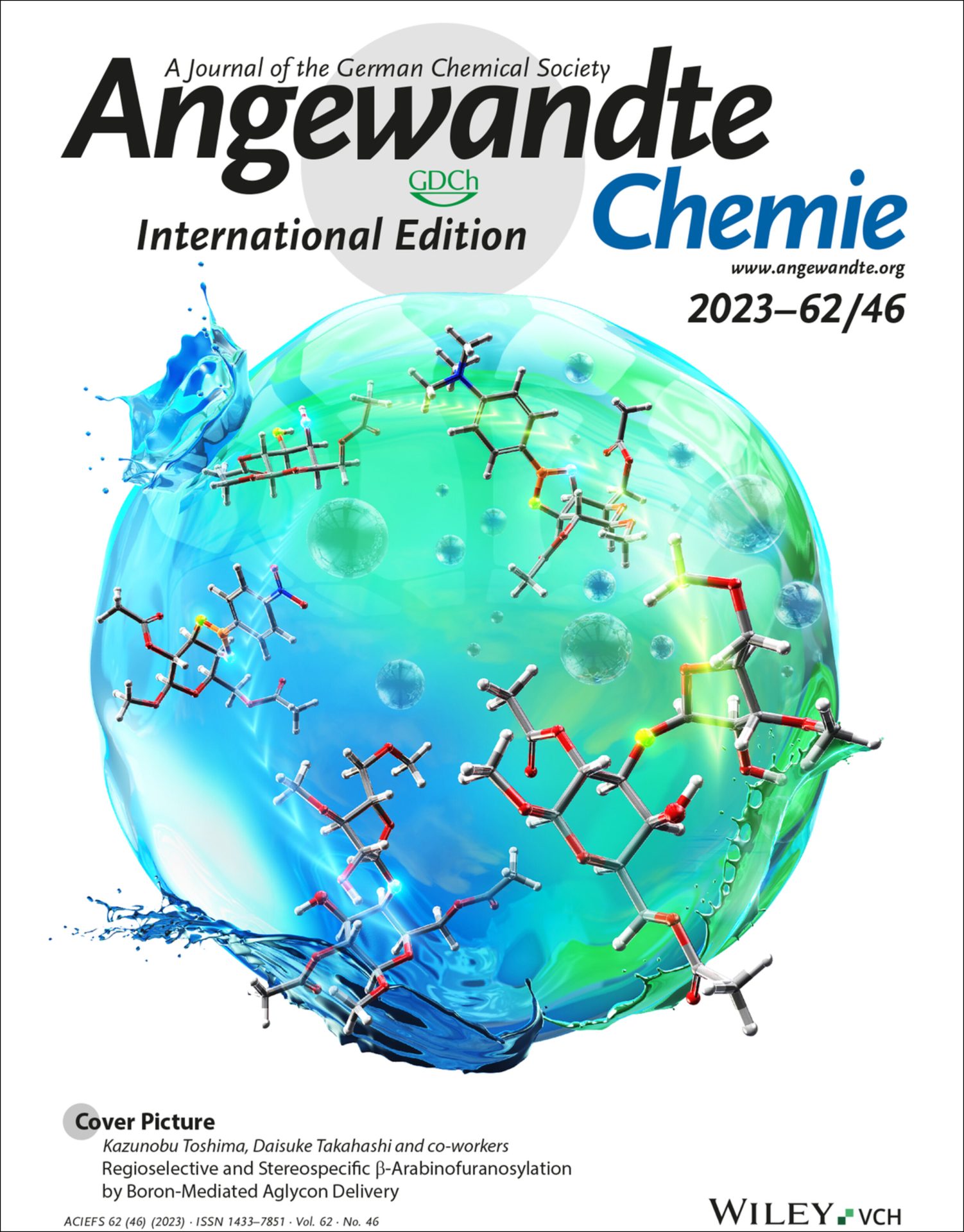
Diversification of a Novel α-Galactosyl Ceramide Hotspot Boosts the Adjuvant Properties in Parenteral and Mucosal Vaccines

Diversification of a Novel α-Galactosyl Ceramide Hotspot Boosts the Adjuvant Properties in Parenteral and Mucosal Vaccines

The development of potent adjuvants is an important step for improving the performance of subunit vaccines. CD1d agonists, such as the prototypical α-galactosyl ceramide (α-GalCer), are of special interest due to their ability to activate iNKT cells and trigger rapid dendritic cell maturation and B-cell activation. Here, we introduce a novel derivatization hotspot at the α-GalCer skeleton, namely the N-substituent at the amide bond. The multicomponent diversification of this previously unexplored glycolipid chemotype space permitted the introduction of a variety of extra functionalities that can either potentiate the adjuvant properties or serve as handles for further conjugation to antigens toward the development of self-adjuvanting vaccines. This strategy led to the discovery of compounds eliciting enhanced antigen-specific T cell stimulation and a higher antibody response when delivered either by parenteral or mucosal route, compared to a known potent CD1d agonist. Notably, various functionalized α-GalCer analogs showed a more potent adjuvant effect after intranasal immunization than a PEGylated α-GalCer analog previously optimized for this purpose. Ultimately, this work could open multiple avenues of opportunity for the use of mucosal vaccines against microbial infections.

Comparative Immune Response after Vaccination with SOBERANA® 02 and SOBERANA® plus Heterologous Scheme and Natural Infection in Young Children

Comparative Immune Response after Vaccination with SOBERANA® 02 and SOBERANA® plus Heterologous Scheme and Natural Infection in Young Children

(1) Background: In children, SARS-CoV-2 infection is mostly accompanied by mild COVID19 symptoms. However, multisystem inflammatory syndrome (MIS-C) and long-term sequelae are often severe complications. Therefore, the protection of the pediatric population against SARSCoV-2 with effective vaccines is particularly important. Here, we compare the humoral and cellular immune responses elicited in children (n = 15, aged 5–11 years) vaccinated with the RBDbased vaccines SOBERANA® 02 and SOBERANA® Plus combined in a heterologous scheme with those from children (n = 10, aged 4–11 years) who recovered from mild symptomatic COVID-19. (2) Methods: Blood samples were taken 14 days after the last dose for vaccinated children and 45–60 days after the infection diagnosis for COVID-19 recovered children. Anti-RBD IgG and ACE2-RBD inhibition were assessed by ELISA; IgA, cytokines, and cytotoxic-related proteins were determined by multiplex assays. Total B and T cell subpopulations and IFN-γ release were measured by multiparametric flow cytometry using a large panel of antibodies after in vitro stimulation with
S1 peptides. (3) Results: Significant higher levels of specific anti-RBD IgG and IgA and ACE2-RBD inhibition capacity were found in vaccinated children in comparison to COVID-19 recovered children. Th1-like and Th2-like CD4+ T cells were also significantly higher in vaccinated subjects. IFN-γ secretion was higher in central memory CD4+ T cells of COVID-19 recovered children, but no differences between both groups were found in the CD4+ and CD8+ T cell effector, terminal effector, and naïve T cell subpopulations. In contrast to low levels of IL-4, high levels of IL-2, IL-6, IFN-γ, and IL-10 suggest a predominant Th1 cell polarization. Cytotoxic-related proteins granzyme A and B, perforin, and granulin were also found in the supernatant after S1 stimulation in both vaccinated and recovered children. (4) Conclusions: Vaccination with the heterologous scheme of SOBERANA® 02/SOBERANA® Plus induces a stronger antibody and cellular immune response compared to natural infections in young children.


Inhibition of Pertussis Toxin by Human α-Defensins-1 and -5: Differential Mechanisms of Action

Inhibition of Pertussis Toxin by Human α-Defensins-1 and -5: Differential Mechanisms of Action

Whooping cough is a severe childhood disease, caused by the bacterium Bordetella pertussis, which releases pertussis toxin (PT) as a major virulence factor. Previously, we identified the human antimicrobial peptides α-defensin-1 and -5 as inhibitors of PT and demonstrated their capacity to inhibit the activity of the PT enzyme subunit PTS1. Here, the underlying mechanism of toxin inhibition was investigated in more detail, which is essential for developing the therapeutic potential of these peptides. Flow cytometry and immunocytochemistry revealed that α-defensin-5 strongly reduced PT binding to, and uptake into cells, whereas α-defensin-1 caused only a mild reduction. Conversely, α-defensin-1, but not α-defensin-5 was taken up into different cell lines and interacted with PTS1 inside cells, based on proximity ligation assay. In-silico modeling revealed specific interaction interfaces for α-defensin-1 with PTS1 and vice versa, unlike α-defensin-5. Dot blot experiments showed that α-defensin-1 binds to PTS1 and even stronger to its substrate protein Gαi in vitro. NADase activity of PTS1 in vitro was not inhibited by α-defensin-1 in the absence of Gαi. Taken together, these results suggest that α-defensin-1 inhibits PT mainly by inhibiting enzyme activity of PTS1, whereas α-defensin-5 mainly inhibits cellular uptake of PT. These findings will pave the way for optimization of α-defensins as novel therapeutics against whooping cough.